An image of pure devotion:
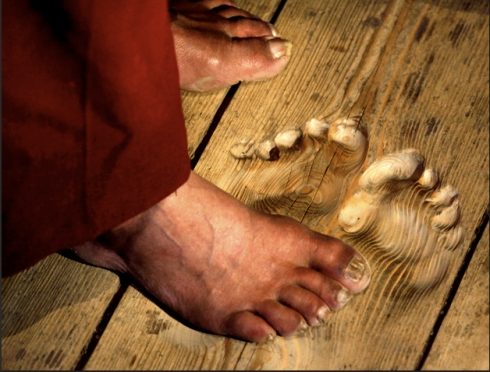
The feet of Hua Chi, who believes he is about 70 years old, are seen next to footprints he has made in wood by praying in the same place for decades, in a monastery near Tongren, Qinghai Province

An image of pure devotion:
The feet of Hua Chi, who believes he is about 70 years old, are seen next to footprints he has made in wood by praying in the same place for decades, in a monastery near Tongren, Qinghai Province
LHASA, China (Reuters) – I had barely stepped off the plane, gasping slightly in the thin Tibetan air, when our government minder wandered over to tell me plans for an evening of rest and adaptation to the high altitude had been canceled.
Instead a dash to see Tibet’s most sacred temple, and a news conference that dragged late into the night, set the gruelling pace for a reporting trip around China’s most sensitive region.
The one-year anniversary of deadly riots and 50th anniversary of the Dalai Lama’s flight into exile are looming in early March. Both are potential triggers for unrest and key tests of China’s control of the closed-off Himalayan plateau.
While China has promised the foreign media unfettered access to most parts of the country since hosting the Olympics, Tibet is an exception. Foreign tourists are also banned at present, except for a lucky few given special permission.
So being one of a dozen journalists taken on the first media visit to the region in months was a rare but daunting opportunity.
Readers outside China are eager for news not filtered by China’s state media, while officials escorting us were equally keen to ensure we saw the region and its troubles from Beijing’s perspective.
Our stamina was strained by an agenda kept largely secret from us but packed from morning until late at night, busy enough to keep us from slipping out to meet ordinary Tibetans.
The area is strategically vital to China for its potentially rich mineral reserves and its snow-fed highlands which are the source of many of Asia’s rivers. Beijing’s rule of the region has also become a sensitive diplomatic issue after a globe-trotting campaign by the Dalai Lama raised Tibet’s profile.
So I was curious to see if the government had relaxed or tightened its control on volatile Lhasa, what ordinary people thought about the upcoming anniversary and whether any of the ethnic tension generated by the riots had dissipated.
Getting a handle on what was really going on in Tibet turned out to be difficult in a hectic, stage-managed four-day visit.
I spent what seemed like half my time arguing against visits to model villages and tourist sites such as palaces, where there was little chance to catch even a controlled glimpse of ordinary life.
I tapped my feet in frustration through trips to a walnut oil processing factory and local astrologers, and simply skipped a meeting with the woman who carried the Olympic torch up Everest.
We were only taken to a second Lhasa monastery after I harassed our unlucky minders and threatened to boycott an unwanted trip to a traditional medicine hospital.
But I was surprised and grateful that officials whose careers could be put on the line by our reporting were willing to show some flexibility. They even let me slip off to a Tibetan market instead of touring the Dalai Lama’s summer residence.
TRUSTING YOUR EYES
Tibet was often breathtakingly beautiful despite the stress and I had a few moments of the unexpected interaction that can make reporting such fun, like when a grinning old pilgrim gave me a slap on the bottom for taking a photo of her devotions.
But we were stalked by disconcerting reminders that in Tibet even our own eyes could not always be trusted.
Locals told us that for our visit, officials had hidden hundreds of paramilitary police who had been keeping order in Lhasa for months. It was the type of large-scale stage-management of reality I thought had been abandoned along with Maoism.
“It’s amazing. The day before you arrived, Lhasa became suddenly peaceful again,” quipped one taxi driver.
When we were taken to a provincial town, police lined many of the villages along our route, their backs to the road so they could keep a close eye on clusters of locals. Officials would not explain why they were there.
And as we were hurried through the halls of Lhasa’s monasteries I asked to meet some rank-and-file monks, the originators of many recent protests in Tibet, but their red-robed superiors said they were locked away in study or otherwise unavailable. A colleague then stumbled across a group of them cooking nearby, but was hurriedly ushered away.
The message Beijing seemed keen to convey was that Tibet was stable and prospering. Yet the careful attempts at managing our perceptions served only to create the opposite impression.
The watchful police, disappearing soldiers, sequestered monks, and days packed with irrelevant visits left me convinced that China thinks Tibet is dangerously volatile, and worries about both its grip on the place and international opinion.
The one thing I am still unsure about, despite my best efforts, is the opinions of ordinary Tibetans outside the government apparatus that showed us around.
Beyond a raised eyebrow or an unhappy grimace, none wanted to open up.
“It’s difficult here. We don’t dare talk” was the best I could get.
Visiting Chinese official on Thursday asked Nepal to control possible anti-China activities in the upcoming months on its soil, according to media reports.

March 10 this year marks the 50th anniversary of the Tibetan Uprising, which forced Tibetan leader the Dalai Lama and thousands of Tibetans to flee into exile in 1959.
In 1959, anti-Chinese and anti-Communist revolt erupted in Lhasa leading to the deaths of 86,000 Tibetans and the Dalai Lama was forced to flee into exile, according to figures of the Tibetan government-in-exile in India.
Chinese Assistant Foreign Minister Hu Zhengyue arrived arrived in Kathmandu with a 13-member delegation on Wednesday. The delegation met with Prime Minister Pushpa Kamal Dahal, Defence Minister Ram Bahadur Thapa, and other senior government officials and urged them to curb possible anti-China demonstrations.
During the meeting with Nepali officials on Thursday, Zhengyue said that the year 2009 was a “sensitive year” for China and urged increased surveillance to curb anti-China activities on Nepali soil, ekantipur.com reported.
During the visit to Nepal in December, Chinese Foreign Minister Yang Jiechi had also expressed concern regarding possible “Free Tibet” protests in Nepal in 2009.
Prime Minister Dahal reaffirmed Nepal’s commitment to adopt strong measures to control anti-China activities, media reports quoted his Press Advisor Om Sharma as saying. Defence Minister Thapa also reportedly told the delegation that the government would beef up security along Nepal-China border to prevent the “Dalai Lama’s supporters from entering Tibet.”
“We are committed to addressing the national security concerns of China,” Thapa told reporters after meeting the delegation. He, however, maintained that the matter was “more than a bilateral issue” between Nepal and China. “The issue of Tibet is a tripartite issue between Nepal, India and China. So the three countries must work together to solve it,” Thapa told reporters.
According to media reports, the delegation also met with Home Secretary, Chief of Nepal Police and Chief of the Armed Police Force jointly and held an hour’s discussion on ways to control anti-China activities.
Chinese Assistant Foreign Minister described the development as being “regular and normal exchange” of the visits.
As usual, the exchanges have, however, come not without Beijing’s favour to increase its aids to the economically-starved landlocked Himalayan country. The Chinese envoy reportedly told the Nepalese counterparts that his government was going to increase its assistance to Nepal in various fields.
Nepalese foreign ministry spokesman Suresh Pradhan said Prime Minister Dahal will make an official visit to Beijing by the end of April or the first half of May.
During the meeting, Prime Minister Dahal also reportedly requested the Chinese side to fund the construction of the 400 MW Narsinghgad Hydropower Project in Jajarkot as a “gift project.”
It is also reported that during the Nepalese prime minister’s trip to Beijing, both governments would finalise a landmark Peace and Friendship Treaty, which would redefine the relationship between China and Nepal.
The Chinese delegation is scheduled to leave for New Delhi on Friday, media reports said.
Tibetans in Kathmandu and elsewhere in Nepal staged some of the most sustained and regular anti-China protests last year after unrest against Chinese rule in Tibet faced brutal Chinese military crackdown.
A group of self-proclaimed Tibetan activists on Wednesday, which marked the first day of Tibetan New Year, hoisted a Tibetan National flag on the wall of Chinese Embassy’s visa office in Kathmandu and painted “Free Tibet” on its main gate.

The district administration in Kathmandu, which last year witnessed continuous protests by Tibetans for almost eight months, has prohibited all protests near the Chinese embassy and its visa office from Saturday, IANS reported today.
According to the report, the indefinite curb extends to all areas within 200 metres of the Chinese embassy.
Nepal had come under international criticism last year for its brutal treatment of Tibetan protesters, and was accused of acting under pressure from China.
Nepal police this week arrested twelve Tibetan nationals, including four women, who entered the country through Nepal-Tibet border and were handed over to authorities in kathmandu.
Every year, many Tibetans escape via Nepal to India, often after undertaking incredibly risky journey across the harsh Himalayan terrains.
I am just one person. I have been posting news articles in this blog for 2 years, including my trip to Dharamsala in 2007. I find it hard to post reports on the Tibetan issue because I feel my view is not valid or taken into account. I am a Westerner and as such have no place getting involved in the affairs of Tibetans.
But, I just want to help. Tibet and her people are very close to my heart–for many, many reasons that go back to my childhood. Another part of this, is that I know what it’s like to be beaten and abused, I know what it’s like to be imprisoned, and I know what it’s like to lose my country.
But, I am just one person.
One small person who does what she can but whose actions change nothing. Sure, my videos are “nice” and “supportive” and my words are thrown out into the chasm of cyberspace, but I can change nothing.
And it frustrates me. Chinese people tell me I don’t know what I’m talking about, Tibetan people tell me I don’t know what I’m talking about–because I’m foreign to their worlds.
Torture and suppression is the same the world over. I know what I’m talking about… and I want to help.
But, I’m just one person.
This blog has come to be my only avenue for spreading the word about Tibetan issues. I’ve been part of other movements, but they always contain too much ego. Too many “big men” looking for fame and risking the integrity of the cause. I don’t know what to do. I have no money. I have no skill other than compassion and a desire to right the wrongs.
I’ve taught myself some Tibetan, but I live far from any communities where I can offer even basic assistance. Part of me feels that I am not wanted in the cause–only my money is wanted. That’s harsh to say–but, when I’ve been told that I am the wrong ethnicity to “understand” how am I supposed to feel??
Do Tibetans really feel that way? That Westerners are not welcome in their fight? I know already how the Chinese feel about me from comments left on this blog and my youtube and facebook accounts as well as threatening emails and viruses sent to me.
I don’t know. Maybe I’ve got all of this wrong–but maybe I’m not welcome, and I’d rather know now….
Chinese police today shot a burning Tibetan monk before they put him out, the Free Tibet campaign said.
The monk had set himself on fire in a protest over Tibetan new year rituals in Aba county, Sichuan province, the group said. The area saw some of the worst unrest during Tibetan protests last March.
Free Tibet said witnesses saw Tabe, a monk aged in his 20s, walking from Kirti monastery into town this afternoon. He was carrying a hand-drawn Tibetan flag with a picture of the Dalai Lama at its centre.
“He doused himself in petrol. The armed police could not get near him because he was burning,” said Matt Whitticase, a campaign spokesman. “Witnesses heard three gunshots fired. The monk fell to the ground and the police managed to put the flames out. He was immediately put into a van and taken to an undisclosed location. His present condition is unknown.”
The claims could not be confirmed independently, but Whitticase said the group had indirect accounts from three witnesses. Tibetans have been heavily punished for passing details of incidents to outsiders.
Free Tibet said up to 800 monks had reportedly gone to Tabe’s home village of Trinkin to say prayers, believing him to be dead.
The group said Tabe’s protest followed an attempt by almost 1,000 monks at Kirte to use a prayer hall to observe the Monlam festival – part of Tibetan new year – despite being told not to do so. They were told to return to their rooms.
The authorities have been angered by some Tibetans deciding to boycott new year celebrations other than religious rituals as a mark of protest against Chinese rule.
Last year, Tibetan exile groups said police shot dead several protestors in Aba county. The campaigners released graphic photographs of bodies and the names of five alleged victims.
Chinese state media subsequently said that officers shot and wounded “rioters” in self-defence.
More than 100 monks from the Lutsang monastery in Qinghai province held a candlelit vigil and protest march on Wednesday, the US government-funded Radio Free Asia reported today.
By Woeser, translated by High Peaks Pure Earth
Losar is almost upon us and, as we all know, Tibetans have very different feelings towards this year’s Losar. The concerned authorities took notice of this very early on. Party Secretary Zhang Qingli has repeatedly given the orders, saying “playing the first move of the chess well, and wage a war on one’s initiative well”. Various state media have attributed this “Not celebrating Losar” to the Tibetan Government in Exile and the Tibetan Youth Congress. In reality, “Not celebrating Losar” was first proposed by Tibetans in Tibet and originated out of spontaneous wishes. Nobody organized Tibetans “Not celebrating Losar”; nobody called on Tibetans “not to celebrate Losar”, no, no. However, the impact is tremendous, everyone is aware of this great ‘civil disobedience’ all over Tibet.
Some say that this kind of “civil disobedience” is only at a low-level, that it is merely not celebrating and nothing more. They maintain that it is a safe action which ends on the individual level, is short-term and does not entail much great risk. In fact, this is not true. Over the past year, the military might all over Tibet has been so great that all Tibetan areas have become prison-like. In today when you could even be arrested for listening to music, “not to celebrate Losar” has been regarded as a serious “separatist” activity, so much so that some Tibetans have been accused of spreading “not to celebrate Losar” rumours and been arrested. In fact, ‘civil disobedience’ in Tibetan areas is even more difficult to carry out than in other places, therefore any kind of result obtained is worth paying attention to.
The way this government treats Tibetans is inhuman. Any kind of Tibetan demands have been trampled on contemptuously. All Tibetan hopes have been shattered contemptuously. The Dalai Lama has not been able to return to his own homeland for fifty years. The Panchen Lama has been missing from the world for thirteen years. It has been ten years since the Karmapa left his home…there is also the wrongly imprisoned Tenzin Delek Rinpoche, how many elderly people in Kham called out his name as they breathed their last words, and they all died with the injustice unaddressed. Those locals haven’t been celebrating any festivals or holidays for the last few years…Many predictions have become an alarming reality, the thirteenth Dalai Lama once said: “Tibetan people will be stripped of their rights and property, and we will become the slaves of the invaders…” One of my monk friend’s 70 year old mother took to the streets last year to protest. Later, a working group went from door to door to investigate why they had participated in protest, were they not demanding “Tibetan Independence”? The old woman said: “Independence or no independence, I don’t know, neither do I understand it, but I know very well that we don’t have freedom, we don’t have rights, I took to the streets, and what I want is freedom and rights.”
And Tibetans have never stopped voicing their demands and protesting: major episodes of dissent occurred in 1959, 1969, 1979, 1989, 1999… and right up until last year when the scale of demonstrations shocked the world. Of course, the inhumanness of the authorities once again became reality: its response is still heavily armed military police, armoured vehicles and jails. It has always been nothing but “strike hard” campaigns. People who live under such state violence usually fear the violence, and they have to be silent because of their fear. It is a long-term silence and a silence in which people are leading a befuddled life. It is also a silence in which “people are deeply grateful”; and it is a silence in which they can only prostrate, hang up prayer flags and distribute lungtas (wind-horses)… This is not something one can not understand. But this time it is different.
A Tibetan went back to Lhasa from the west and after spending a short time very cautiously, he returned to the free world. He sent me a letter and said that when he went back before, he was always disappointed with what he found. He said people only talked about money or having fun. But this time when he went back he felt there was hope because it was totally different. I also have a Tibetan friend who went back to Amdo from a Chinese area. This friend visited cities and towns and villages and he was encouraged by everyone he met: everyone from government officials to herdsmen from his hometown. So he told me: “I have been surprised again. Last year Tibetans surprised everyone, and this year it’s the same. This is so great, we are of one mind. It gives people hope.”
What’s striking here is that these two friends independently expressed to me their hope. And this struck me as unusual. It reminded of a Czech intellectual who once commented on the relationship between the citizens and the unjust authorities: The more one acts like a slave and a servant, and is full of fear, the less seriously the authorities will take you. Only if you have them understand that injustice and despotism can not proceed without obstruction, will you have some hope that they will restrain themselves to some extent. People must forever keep their dignity, not to be scared of threat, not to servilely beg others, and only to tell the truth. In doing so, people can create a kind of pressure because all these are acutely set against the actions of the authorities.”
19th February, 2009, Beijing
From Phayul:
Inside Tibet people have made the decision not to celebrate Losar this year. It appears to be not just an expression of sorrow for those Tibetan shot, tortured and imprisoned in last years uprising, but also an act of defiance against the Chinese government that wants to show the world that Tibetans enjoy religious and cultural freedoms under its rule. In exile there has been some debate on whether or not to celebrate Losar. There are valid arguments on both sides, but then again the logic of revolution is another thing altogether. When the struggle calls we can only obey.
Earlier I had written a cultural essay for Losar, but then I decided on a a more political gift for Rangzen advocates and activists. The following piece is actually a pamphlet to be distributed on March 10 and future rallies and meeting, but I thought that those who believe in Rangzen might enjoying sitting back with a chang-koe and reading it on Losar day. Most of us have a general idea of the facts that have been presented before the UN and the world, to show that Tibet was an independent country before the Communist invasion: treaties, the Shakabpa passport, the flag and so on. I have tried to provide details that are probably not that well known but which I hope will edify and perhaps even cheer and encourage.
I have attempted to be scrupulously honest with the facts and have provided authentic references for nearly every claim or statement made in the pamphlet. Since the pamphlet had to be kept short, all the references, additional material, related documentation, photographs, maps, illustrations, audio clips and bibliography will be on a website http://www.rangzen.net. You can access what you want on the section “Independent Tibet – Some Facts” and clicking on the reference number.
The fully laid-out and illustrated pamphlet can be downloaded (in black & white or colour) at the website and can be printed at home or at a commercial printer. Individuals or organization can print and distribute the pamphlet, and space is provided on the front cover for the organizations credit line. The website will be up in a few days – definitely before March 10.
INDEPENDENT TIBET – SOME FACTS
Compiled by Jamyang Norbu for the Rangzen Alliance

FUNCTIONING STATE
Before the Chinese Communist invasion of 1950 Tibet was a fully functioning and independent state. It threatened none of its neighbors, fed its population unfailingly, year after year, with no help from the outside world. Tibet owed no money to any country or international institutions, and maintained basic law and order. Tibet banned capital punishment in 1913 (mentioned by a number of foreign travelers [1]) and was one of the first countries in the world to do so. There is no record of it persecuting minorities (e.g. Muslims [2]) or massacring sections of its population from time to time as China and some other countries do – remember Tiananmen. Although its frontiers with India, Nepal and Bhutan were completely unguarded, very few Tibetans fled their country as economic or political refugees. There was not a single Tibetan immigrant in the USA or Europe before the Communist invasion.
PARIS – The former partner of Yves Saint Laurent, who is selling the art collection he built up with the late fashion designer, said he would hand over two sculptures claimed by China — but only if Beijing agreed to free Tibet.
Pierre Berge, Saint Laurent’s former business partner and companion, is organizing the biggest private auction of art seen in Paris for years, selling the huge collection built up by the two in a three-day auction next week.
Among the works of art are two Chinese bronze sculptures of a rabbit and a rat head, taken during the Opium Wars of the 19th century that the Beijing government said earlier this month belonged to China and should not be auctioned.
Berge said he was not concerned by a claim due to be heard by Paris judges on Monday seeking to have the bronzes returned.
“I acquired them and I am completely protected by the law, so what the Chinese are saying is a bit ridiculous,” he told Reuters Television on Friday. “But I am prepared to offer this bronze head to the Chinese straight away.”
“All they have to do is to declare they are going to apply human rights, give the Tibetans back their freedom and agree to accept the Dalai Lama on their territory,” he said.
“If they do that, I would be very happy to go myself and bring these two Chinese heads to put them in the Summer Palace in Beijing.”
“It’s obviously blackmail but I accept that,” he said.
Chinese troops marched into Tibet in 1950 and the region’s spiritual leader, the Dalai Lama, fled into exile in 1959 after a failed uprising against Beijing’s rule.
The official Xinhua news agency said earlier this month that the two sculptures, estimated to be worth 8-10 million euros ($10-12 million) each, were taken from Beijing’s Imperial Summer Palace, burned down by invading French and British forces in 1860.
Xinhua said China and France signed a 1995 convention on stolen or illegally exported cultural objects, “which stipulated that any cultural object looted or lost because of reasons of war should be returned without any limitation of time span.”
The Berge-Saint Laurent collection, gathered over decades, ranges from the two Chinese bronzes to paintings by Picasso, Matisse and Degas as well as art deco treasures and ancient Roman and baroque sculptures.
Saint Laurent, whose clothing designs revolutionized women’s fashion, died at the age of 71 last year and bequeathed his share of the collection to the charitable foundation he set up with Berge.
Auctioneers Christie’s expect the sale to raise up to 300 million euros, which Berge has said he will donate to AIDS research.


 BBC World News


 Memories Of Movement